






Serving Montgomery, Bucks, Chester, Delaware & Berks Counties

Montgomery County Fly Control

Also Serving Chester, Bucks, and Delaware Counties

Getting rid of flies in your home or office space can be tricky. It’s easy enough for them to get in — we’ve all left the door or window open a crack on a nice day to let the breeze flow through. Unfortunately, the flies can also come flowing through. Instead of not enjoying the fresh air, let Pest Control Technicians give you high-quality professional fly control services.

  • PPM association inc
  • member of community
  • montgomery country
  • npma
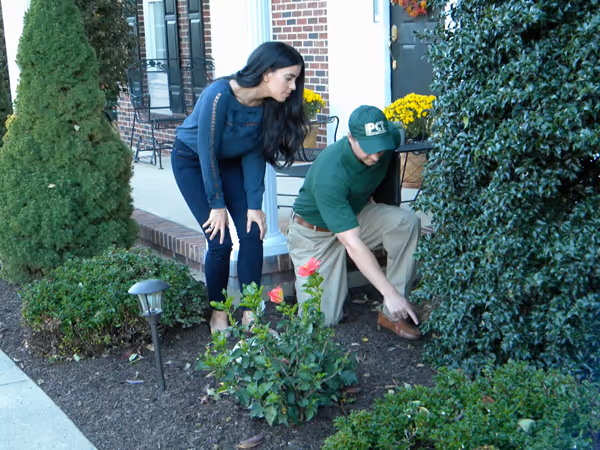
Pest control technician inspecting outdoor conditions with homeowner during fly pest control services.

Detailed Inspections Completed by EPA-Awarded Exterminators

Flies can travel great distances to enter your home. The exterminators at Pest Control Technicians are well-versed in fly biology and habits, which hold the key to effective control. Identifying the species of fly, whether large or small, is very important because each fly occupies its own ecological niche. If flies are making you crazy and you and your customers have had enough, it is time to call Pest Control Technicians.

When inspecting your house for flies, our exterminators generally follow this process:

  • Identify the infesting species.
  • Locate the breeding sources specific to the fly — outside, they can come from trash and garbage or even a dead animal. Inside flies could breed in organic material found in floor drains, food debris, or broken sanitary sewer pipes.
  • Note any sanitation or repair deficiencies.
  • Recommend effective repair and treatment solutions.

Many people feel that nothing can be done for small infestations. This is not the case. Many effective materials for fly control exist, including biological treatments, insect growth regulators, insect light traps, and numerous other measures.

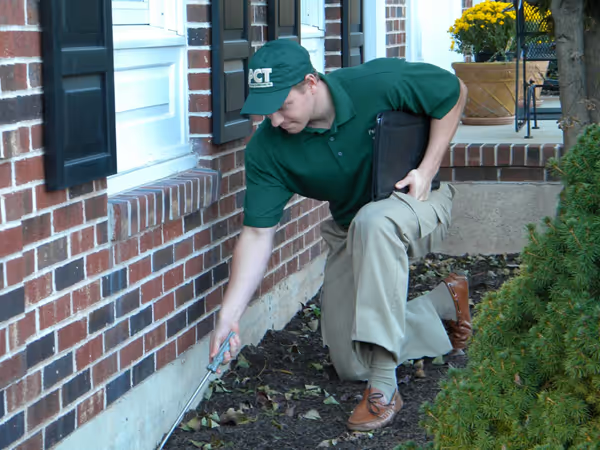
Technician treating outside areas of a house to reduce risks during fly pest control services.

What Our Customers Are Saying

  • PPM association inc
  • member of community
  • montgomery country
  • npma
  • "I definitely recommend!"

    Will was very professional & explained every step of the process.

    - Amelia G.

  • "Been using them for years in the building I manage"

    Above and beyond on their treatment. Excellent.

    - Pete F.

  • "Thank you Blake We really appreciate you!!"

    We have been using you guys for quite some time now in one of our businesses.

    - Lisa B.

Read More Reviews

How to Prevent Infestations of House Flies

Just like with other pests, there are some preventative measures that can be taken to avoid a house fly infestation. Those tips include:

  • Sanitation: Keeping your home clean is key, especially in your kitchen. Flies are attracted to the food you eat, and when it isn’t available to them, they aren’t as drawn to your living spaces.
  • Check your doors and windows: Before you open your doors and windows to feel that cool summer breeze, make sure there aren’t any missing or damaged screens. It doesn’t take a very large opening for a fly to fit through.
  • Keep your garbage cans clean: Wipe out your garbage cans regularly to avoid a buildup of food and other residues that attract flies. All garbage cans and dumpsters should also have a very secure lid.
  • Clean up after your pets: Keeping your pet’s waste cleaned up in your yard is a great way to keep flies away.

The Importance of Safe Treatments in Fly Control

Homeowners may worry about the potential risks of pest control treatments, especially when children, pets, and outdoor landscaping are involved. Flies aren’t just a nuisance — they can carry harmful bacteria that threaten your family’s health. That’s why it’s crucial to prioritize safe, targeted solutions that eliminate flies without putting the well-being of your loved ones or the environment in jeopardy. Pest Control Technicians uses eco-friendly, low-risk methods designed to focus on the source of the infestation while protecting the safety of your household and surrounding flora.

We use precision techniques, such as baits, traps, and exclusion methods, all customized to your property’s specific needs. These methods are carefully chosen to minimize exposure to chemicals while preserving your lawn, garden, and outdoor spaces. By opting for sustainable pest control solutions, you not only resolve the immediate issue of flies but also maintain a healthy, vibrant environment.

Grayscale image of a suburban home exterior with landscaping symbolizing pest-free living through pest control services.

Keep Your Home Pest-Free All Year!

All Seasons will eliminate all current infestations and protect your home against household pests for the long haul. Our Residential Service program is a subscription service with quarterly treatment that also provides service throughout the year whenever you’re having an issue.

Interesting Facts About House Flies

If you’re seeing house flies around, you may want to know more about them. Here are some interesting facts about house flies:

  • Flies are carriers of disease

    While not as common in the United States, flies are commonly known to carry many types of bacteria, including typhoid, bubonic plague, tuberculosis, gangrene, and even leprosy.

  • Flies don’t have a mouth

    They actually eat their meal through a tube. Before eating any food, they have to spit or vomit fluid from their stomachs to break down their meal into liquid. The house fly then sucks it up, usually leaving germs behind.

  • Flies have multiple lenses

    There are four thousand lenses in each eye, eight thousand in total. However, they still don’t have great eyesight.

  • Flies multiply quickly

    Females can lay up to 2,500 eggs each month. Flies are fully developed from egg to adult in 10 days.

Grayscale image of a suburban home exterior with landscaping symbolizing pest-free living through pest control services.

Don’t Miss Out on These Savings!

The Spotted Lantern Fly: What You Need to Know

The Spotted Lantern Fly (SLF) is an invasive species that came to our shores from Asia. SLFs hatch out in early summer and appear as small black insects with white spots on them. These are the nymphs or immature SLFs. As adults, they turn red with spotting on their multiple sets of wings and develop into flying insects.

Get Your Custom Pest Solution Today!

At Pest Control Technicians, Inc., we understand that every pest problem is unique. Our team provides customized eco-friendly solutions and maintains open communication, ensuring peace of mind with a treatment plan tailored to your specific needs. Get in touch now!

PCT technician talking with a customer and reviewing pest solutions.

Contact Pest Control
Technicians Today!

A member of our team will be in touch shortly to confirm your contact details or address questions you may have.

Correct First Name is Required
Correct Last Name is Required
Correct Phone is Required
Correct Email is Required
Correct Address is Required
Correct Message is Required
Thank you! Your submission has been received!
Oops! Something went wrong while submitting the form.

Our FAQs

Have questions? We are here to help. Still have questions or can't find the answer you need? Give us a call at (610) 275-7378 today!

  • How can PCT help?

    PCT was one of the first companies in the area to identify SLF and develop effective treatment techniques for these invasive pests. If you see SLF congregating on or near your home call PCT at (610) 275-7378 for effective treatments before they lay egg masses or damage outdoor items.

  • Can they harm your home?

    SLF can cause numerous problems for homeowners as well besides weakening or killing desirable plants. Egg masses are sometimes laid on the sides of buildings and can be difficult to remove. If a car is parked under a tree where SLF are feeding, fecal residue from the SLF drops down from the tree and gets on the car, boat, or other finishes, and is very difficult to remove. SLF can congregate in large numbers not only on homes, but also on high-rise buildings.

  • Are they harmful?

    These insects threaten some agricultural products such as grapevines and even maple trees. SLF attaches to the branch of the plant they choose to feed upon and begin to drain the nutritional sap from the tree. Some trees will have over 1 thousand SLF feeding at one time. With this level of feeding, the plant or tree becomes weakened or just dies outright from lack of nourishment.

  • What do they eat?

    In the late summer and fall, the spotted lanternfly prefers feeding on Ailanthus altissima, commonly known as the “Tree of Heaven.” They can be found feeding on other plants and maple and stone fruit trees. The Tree of Heaven is also an invasive species that is found along the road right of ways and in strips of woods and weeds.